UoD Spatial Planning Students Complete Immersive Annual Summer School in Germany
UoD – September , 2026 | University Press Office (UNPO) –
The Department of Spatial Planning at the College of City and Regional Planning successfully continued its esteemed annual Summer School in Germany Program from August 15 to September 4, 2026.
This year’s immersive three-week journey provided the 6th-semester Spatial Planning students with an unparalleled opportunity for intense academic immersion and meaningful cross-cultural exchange. It stands as a core milestone of the joint agreement between the UoD College of City and Regional Planning and TU Dortmund University, effectively bridging the gap between international planning theory and real-world execution.
The students were accompanied throughout the program by Dr. Rezgar Mostafa Mohammed, Head of the Department of Spatial Planning at UoD, and Dr. Johannes Lückenkötter, Program Coordinator from TU Dortmund University.
A Journey Through German Planning Landscapes
To expand their perspective beyond the classroom, the students traveled to major German hubs, exploring unique facets of The German Planning System, Urban Evolution, and Sustainable Infrastructure.
Week 1: Connecting Classroom Theory with Frankfurt's Reality (August 15 – 22)
During their first week based in Frankfurt, students engaged directly with planning professionals and local experts. The excursions explored critical contemporary planning topics, including:
- Data Centers & AI Infrastructure: Analyzing the unique spatial demands of modern digital economies.
- Large-Scale Settlement Planning: Examining the development of new, comprehensive residential areas.
- Community Housing & Urban Greening: Investigating innovative, sustainable solutions for urban living and public space.
Throughout these visits, students were encouraged not just to observe, but to ask questions, discuss, and reflect—making this a critical opportunity to learn directly from the German planning experience.
Week 2: From Industrial Heritage to Climate Adaptation in Dortmund (August 23 – 28)
In the second week, the group stepped out to explore urban planning in practice across Dortmund and Münster. The journey focused heavily on the Ruhr District's renowned industrial heritage and its ongoing structural transformation.
Key learning moments included:
- Regeneration of Industrial Sites: Observing sites like Lake Phoenix to understand how cities respond to changing economic and social needs.
- Climate Adaptation: Exploring urban parks and discussing crucial issues such as flash floods, heat stress, and participatory planning for post-disaster reconstruction.
- Active Mobility: Analyzing cycling and transport policies in action.
Along the way, the students compared different approaches to urban reconstruction, reflecting on how history and local identity shape the essential “spirit of a place.”
Week 3: Tackling Berlin's Contemporary Challenges (August 29 – September 4)
The group concluded their fruitful summer school with an intensive week in Berlin, combining academic rigor with first-hand experience of the capital's unique urban spaces.
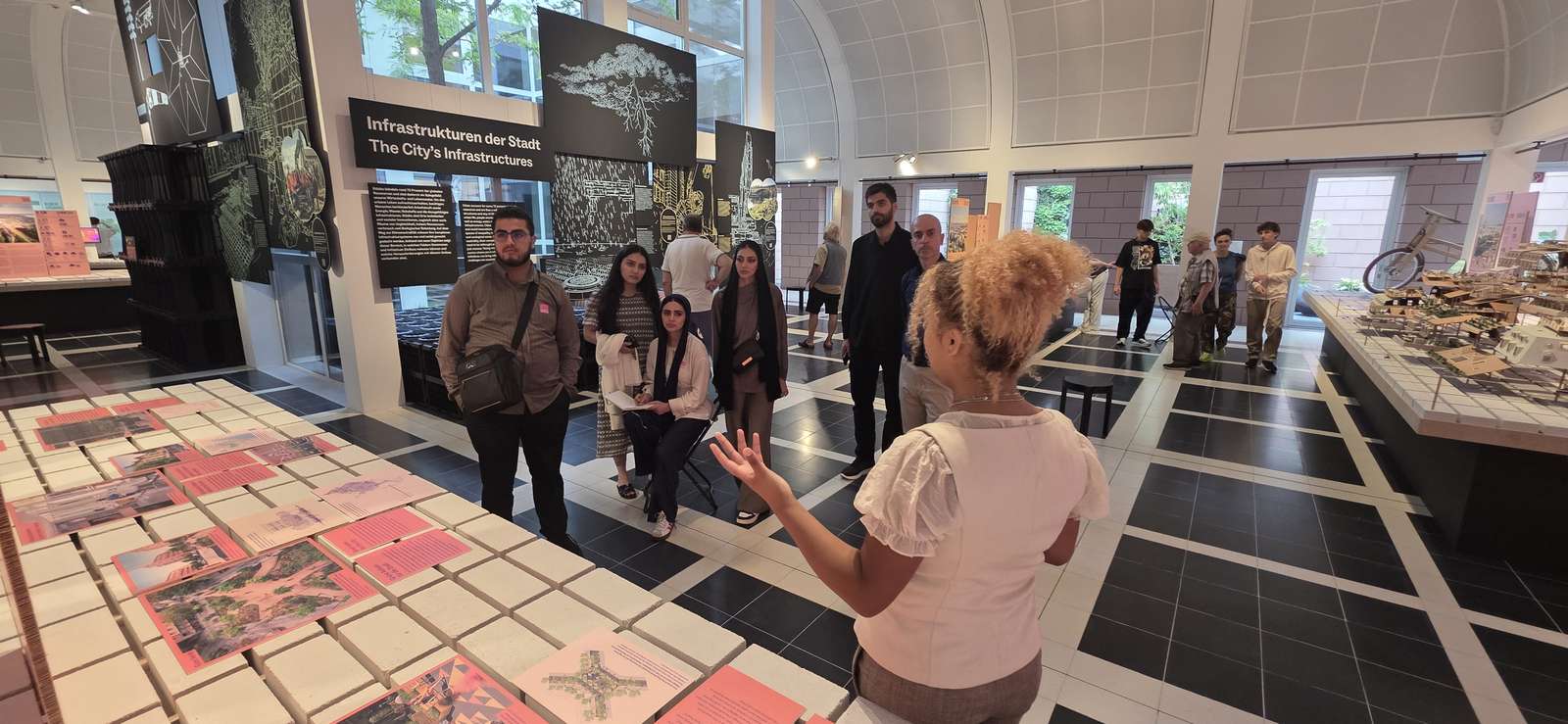
- Students explored the history of Berlin’s urban development and planning, worked with city models, and discovered the historic city center from a different perspective during a guided boat tour. The week also allowed students to observe how planning ideas are translated into real places and neighbourhoods.
- The field visits focused on important contemporary challenges in urban development, including housing, urban renewal, collective living, green infrastructure and climate adaptation. At Rummelsburger Bucht, for example, students explored the idea of the “sponge city” and innovative approaches to rainwater management. They also visited Friedrichstadt and Railway Triangle Park to discuss the relationship between housing, public spaces and green areas.
- Beyond the lectures and visits, the week was also about discussion, observation, exchanging ideas, and learning from one another. Experiencing Berlin directly provided students with valuable insights into how a major city responds to both its historical legacy and the challenges of the future.
For more information on the Summer School Program, visit our website: https://crp.uod.ac/departments/spatial-planning/summer-school-in-germany/
Alignment with UOD’s Strategic Vision
This international collaboration directly supports the University of Duhok’s Strategic Plan (2023–2038), particularly the pillars of:
- Internationalization & Global Academic Partnerships by strengthening our long-standing joint agreement with TU Dortmund University
- Student-Centered & Practical Learning, moving beyond traditional classroom lectures, the program exemplifies UoD’s commitment to experiential learning
- Local Impact & Knowledge Transfer by challenging students to adapt German planning models (such as participatory governance, urban greening, and public transportation) to the local context of Duhok and the Kurdistan Region
CLICK HERE TO VIEW THE MEDIA COVERAGE FOR THIS EVENT
University Press Office – September 13, 2026
Reported by: Fatima Mahmood Ali, Aland Kamal Othman
Photography: Rezgar Mostafa Mohammed
Keywords:
- University of Duhok
- Spatial Planning
- Summer School in Germany
- TU Dortmund University
- Sustainable Development
- Internationalization