In the Presence of President Masoud Barzani and the KRG Prime Minister, UOD Hosts the 5th International Conference on the Genocide of the Kurdish People
UOD – October 28, 2025 – University Press Office |
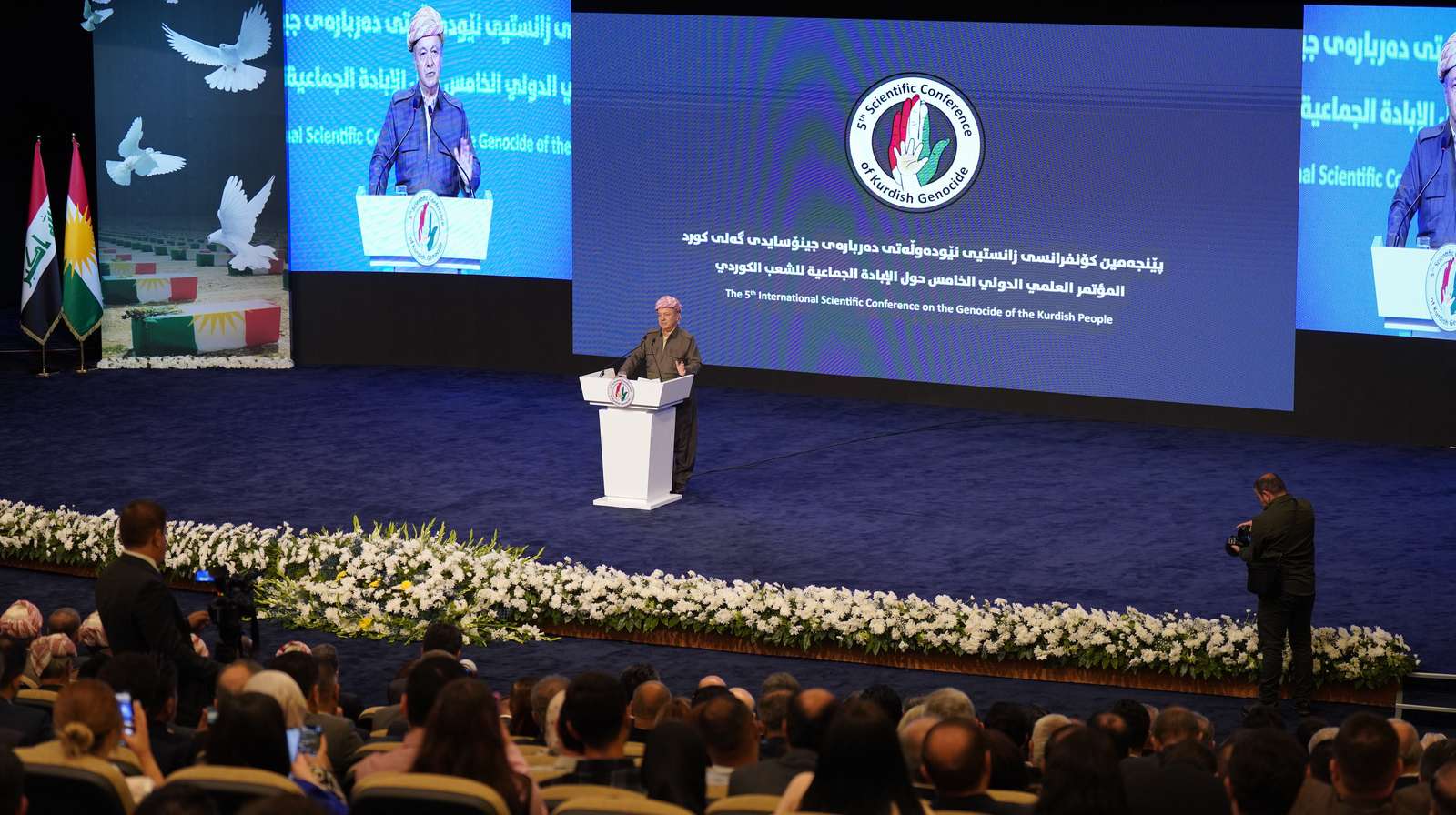
The University of Duhok (UOD) inaugurated the 5th International Scientific Conference on the Genocide of the Kurdish People, held under the esteemed presence of H. E. President Masoud Barzani, the Prime Minister of the Kurdistan Regional Government (KRG), H. E. Masrour Barzani, high-level representatives of the Presidency of the Republic of Iraq and Prime Minister of the Federal Republic of Iraq.
The two-day conference holding the slogan: “Scientific Documentation of Anfal Crimes and Mass Graves: Towards International Recognition of the Genocide of the Kurdish People,” was dedicated to the academic documentation, analysis, and remembrance of the atrocities committed against the Kurdish nation. It is gathering international scholars, researchers, survivors, Parliament members, and senior government officials.
The conference was organized in collaboration with several distinguished academic institutions, including the Hawler Medical University, University of Sulaimani, Erbil Polytechnic University, University of Garmian, Salahaddin University, Soran University, University of Halabja, and Charmo University, under the auspices of the Kurdistan Regional Government (KRG).
The opening speech was delivered by Dr. Yaseen Kareem Ameen, Conference Head from Hawler Medical University, who warmly welcomed the participants and emphasized that science serves as a torch of truth for the cause of the genocide. He highlighted that 182,000 Kurdish people lost their lives during this atrocity and affirmed that, with the continued support of the Kurdistan Regional Government Presidency and President Masoud Barzani, achieving justice for the victims remains both possible and imperative. later, Dr. Yaseen was honored by the Barzani Medal by the esteemed President Masoud Barzani, for his efforts in facilitating the documentation of Anfal crimes.
Dr. Dawood Sulaiman Atrushi, President of the University of Duhok, who welcomed participants on behalf of the participating universities, and reaffirmed the University’s commitment to preserving historical truth and advancing genocide studies. Dr. Dawood mentioned that education and international cooperation is the best form of defence we can present to our nation.
The ceremony featured keynote speeches by national leaders, including a powerful address delivered by His Excellency President Masoud Barzani, who reflected on the historical context of the Kurdish genocide and the ongoing pursuit of justice. His Excellency described the Kurdish people as a “great nation” distinguished by their spirit of forgiveness and their commitment to peace with all peoples. He also emphasized the importance of ensuring that future generations remain aware of the Kurdish cause.
President Barzani further noted that Article 132 of the Iraqi Constitution obligates the government to formally recognize the genocide of the Kurdish people and uphold justice for its victims.
Additional remarks were presented on behalf of the Presidency of the Republic of Iraq, H. E. Mr. Abdullateef Rasheed, and the Prime Minister of the Federal Republic of Iraq, H. E. Mr. Mohammed Shiaa' Al-Sudani their speeches were given by their representatives, underscoring the shared responsibility to acknowledge and learn from this tragic history.
Following the official opening, the scientific sessions began with participation from experts across Iraq, the Kurdistan Region, and abroad.
The discussions covered several key themes, including:
- Documenting Genocide: Forensic evidence, mass graves, and preserving collective memory.
- The Human Toll: Trauma, intergenerational memory, and healing among survivors and affected families.
- Crime and Justice: Legal, psychological, and scientific perspectives on accountability and transitional justice.
The second day continued with in-depth sessions focused on several key pillars. Discussions highlighted:
- The role of modern forensic science in identifying victims and perpetrators.
- The importance of media and activism in preserving memory and achieving international recognition.
- Legal and political pathways necessary to secure justice and accountability.
Attended by Dr. Ameer Chali, Undersecretary of the Ministry of Higher Education in KRG, the conference concluded with a closing ceremony that featured the reading of the conference's recommendations, an honoring ceremony for distinguished contributors, and final remarks.
Official Recommendations:
Presented for the esteemed consideration of the Presidency of the Republic of Iraq, the Prime Minister of the Federal Republic of Iraq, and the Iraqi Parliament.
- Establish a National Center for Genocide Documentation.
- Integrate forensic medicine into higher education curricula.
- Fund comparative research on the Kurdish genocide.
- Create a joint federal and Kurdistan Region research plan on genocide.
- Develop specialized postgraduate studies in forensic medicine.
- Create a national digital archive for all genocide-related records. (Recommended by UOD President)
- Support an annual report on genocide studies from the University of Duhok.
- Form a legal commission to pursue international recognition of the genocide.
- Pass a federal law formally recognizing the Kurdish genocide.
- Guarantee the full legal and financial rights of survivors and their families.
- Incorporate the history of the genocide into national school curricula.
- Establish a national museum for the Kurdish genocide.
- Designate an official National Day of Remembrance for the genocide.
- Promote the role of media in raising public awareness of the genocide.
- Provide comprehensive psychosocial support for victims and their families.
- Establish a national fund to support victims' families and social cohesion.
Afterward, Dr. Falah Hassan, the Head of Non-Governmental Organizations Department in the Kurdistan Region and one of the attendees of the closing ceremony, presented special recommendations. He emphasized that genocide centers and research should be unified to achieve a greater impact.
Finally, the President of the University of Duhok expressed the university's readiness to take any stance or action that would bring the cause of the Kurdish people's genocide to the world.
The event solidified a collective determination to ensure that the genocide of the Kurdish people remains an enduring part of historical memory and a foundation for justice and reconciliation.
CLICK HERE TO VIEW THE MEDIA COVERAGE AND PHOTO GALLERY
University Press Office– October 28, 2025
Reported by: Fatima Mahmood Ali
Photography by: Ali Habib Habib