Runaki Electricity Project Powers Change in Duhok, Reaching 4.5 Million Beneficiaries
Powering Sustainability: University of Duhok Explores the “Runaki” Electricity Project and Its Socio-Economic Impact on Duhok City
UOD, February 2, 2026, University Press Office (UNPO) |
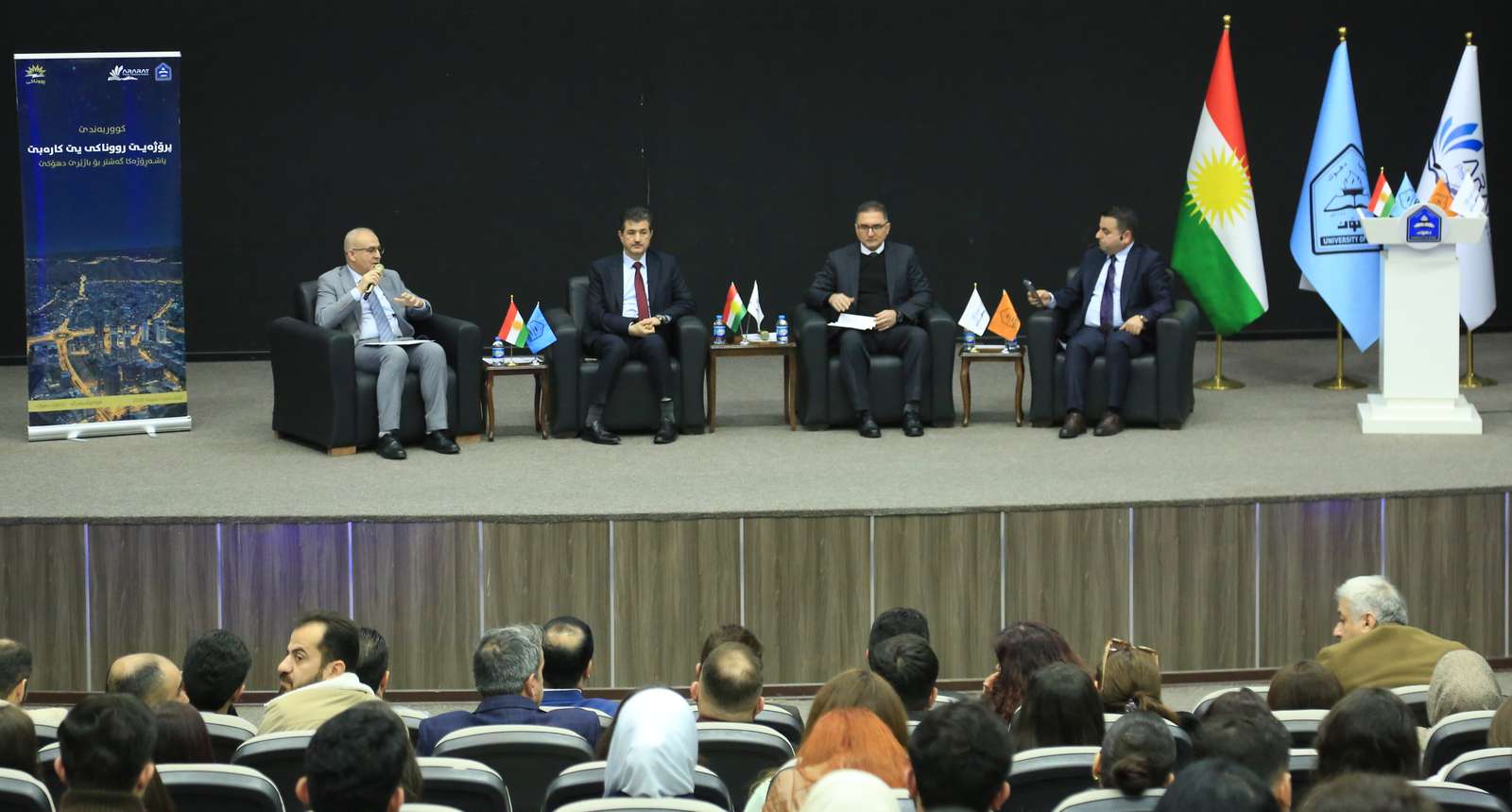
The University of Duhok (UOD), through its College of Engineering, in partnership with the Ararat Technical Institute, organized a high-level scientific symposium on Sunday, 1 February 2026, focusing on the “Runaki Electricity Project” and its technical, environmental, and socio-economic implications for the city of Duhok.
Held under the theme “The Runaki Electricity Project: Benefits, Challenges, and Sustainable Urban Impact,” the symposium reflects the University of Duhok’s strategic commitment to sustainable development, applied scientific research, and evidence-based policymaking in support of community needs and regional development.
High-Level Academic and Institutional Participation
The event was attended by Dr. Lokman Hadi Hassan, Vice President of the University of Duhok for Scientific Affairs and Postgraduate Studies and Dr. Vian Sulaiman, Deputy Head of the Organization Office of the Kurdistan Democratic Party – Duhok, alongside a large audience of academic staff, researchers, and students from both the University of Duhok and Ararat Technical Institute.
The symposium opened with welcoming remarks by Dr. Nashwan Shawkat Mahmood, Dean of the College of Engineering at the University of Duhok, who highlighted the university’s role in linking engineering research with real-life energy challenges. This was followed by a keynote address from Dr. Idris Ali Hassan, Dean of the Ararat Technical Institute, who emphasized the importance of technical education and institutional collaboration in advancing sustainable energy solutions.
Expert Panel on Energy, Environment, and Public Policy
A specialized panel discussion was moderated by Mr. Obaid Subhi, Director of the AVA Media Channel Office-Duhok, bringing together experts from academia, environmental governance, and the electricity sector:
- Dr. Nashwan Shawkat Mahmood, Dean, College of Engineering, University of Duhok
- Engineer Dilshad Abdulrahman Mohammed, Director, Duhok Governorate Environment Directorate
- Engineer Hazem Mahmoud Othman, Assistant Director, General Directorate of Electricity – Duhok Governorate
The panel examined the technical performance, environmental benefits, and operational challenges of the Runaki Project, with a particular focus on its contribution to reducing carbon dioxide (CO₂) emissions, minimizing reliance on private generators, and enhancing urban environmental quality.
Engineer Dilshad stressed that the project has played a key role in lowering CO₂ emissions across Duhok Governorate, positively impacting public health and environmental sustainability.
Meanwhile, Dr. Nashwan showcased the College of Engineering’s ongoing and future research initiatives in renewable energy, energy efficiency, and sustainable power systems, underscoring UOD’s role in raising public awareness on responsible electricity consumption and reducing energy waste.
Engineer Hazem presented data-driven insights on the impact of electricity sector reforms in Duhok, highlighting measurable reductions in emissions, planned project expansion areas, economic feasibility, and mechanisms to lower electricity costs for citizens.
Student Engagement and Knowledge Exchange
The symposium concluded with an open discussion session, enabling participants to engage directly with panelists, followed by the presentation of technical recommendations related to the project’s future development.
At the closing ceremony, certificates of appreciation were awarded by Dr. Lokman Hadi Hassan, Dr. Vian Sulaiman, and Dr. Idris Ali Hassan.
An accompanying panoramic poster exhibition showcased student research projects related to the Runaki Electricity Project, reflecting UOD’s emphasis on student-centered learning and applied research.
Runaki Project: Facts, Impact, and Strategic Significance
The Runaki Electricity Project entered its implementation phase in October 2024. According to official data released at the end of 2025, the project has reached approximately 4.5 million beneficiaries across the governorates of Duhok, Erbil, Sulaymaniyah, and Halabja, as well as the independent administrations of Zakho, Soran, and Raparin.
Key Objectives of the Runaki Project
- Ensuring 24-hour electricity supply.
- Protecting environmental sustainability and public health by reducing emissions and noise pollution.
- Promoting fair and regulated electricity consumption.
- Enhancing the urban visual landscape by removing generator wiring and visual pollution.
More than 130,000 commercial subscribers have benefited from the project, contributing to the shutdown of over 3,700 private electricity generators, covering nearly 70% of the Kurdistan Region.
In line with digital transformation strategies, the Kurdistan Regional Government (KRG) has introduced a mobile application that allows users to monitor electricity consumption and billing data.
In April 2025, the Sarhildan neighborhood in Duhok became the first area in the city to achieve 24-hour electricity supply. Official statistics further indicate that over 50% of Runaki subscribers now pay less than 28,000 IQD per month, demonstrating the project’s economic and social impact.
Beyond Electricity Supply
The Runaki Project represents:
- an environmental initiative by reducing air pollution and emissions,
- a public health intervention by lowering noise and fuel-related pollution,
- and an economic reform project by reducing dependence on costly private generators.
CLICK HERE TO VIEW THE MEDIA COVERAGE FOR THIS EVENT
University Press Office, February 2, 2026
Reported by: Rondik Fadhil Adil
Photography by: Mohammed A. Tahar.
The News Keywords
- University of Duhok sustainability
- Runaki Electricity Project
- Renewable energy Kurdistan Region
- Sustainable urban development Duhok
- Energy efficiency and environmental protection