
UOD Research Unlocks New Optical Solutions for Telecommunications and Optical Fibers
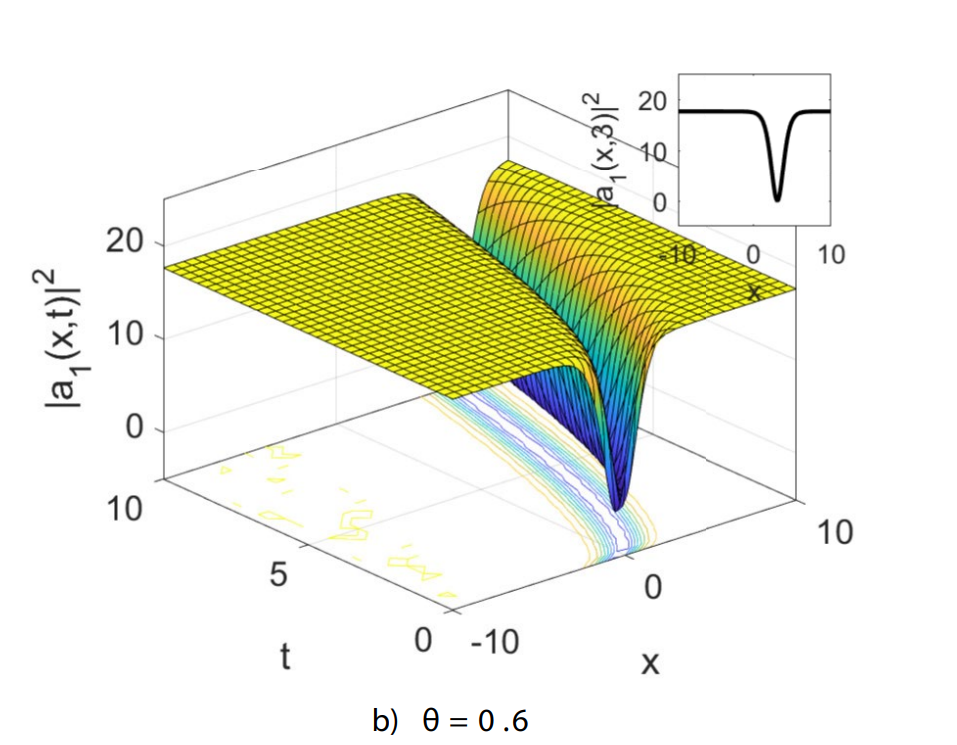
Groundbreaking Study Explores Optical Dromions in the Radha–Lakshmanan Model
In a major advancement in mathematical physics and optical fiber technology, Dr. Muhammad Amin S. Murad from the Department of Mathematics, College of Science (CSCN), University of Duhok (UOD) has co-authored a study investigating optical dromions using fractional temporal evolution in the Radha–Lakshmanan model. Published in the Journal of Optics, this research explores new optical wave structures that could revolutionize high-speed data transmission and signal processing in fiber-optic communications.
🔗 Read the Full Study: DOI: 10.1007/s12596-024-02201-5
Exploring Optical Dromions in Nonlinear Systems
Optical dromions are localized wave packets that maintain their shape and structure over long distances, making them crucial for next-generation optical networks. The study revisits the Radha–Lakshmanan model, a nonlinear equation governing the behavior of optical solitons. By employing fractional temporal evolution, the researchers successfully retrieved multiple optical dromion solutions, offering a new approach to controlling optical signals in telecommunication networks.
The methodology used in this study, known as the Modified Simplest Equation Algorithm, provides a robust framework for generating diverse optical wave structures, including dark solitons, singular solitons, and straddled dromions. These findings hold promising applications in fiber-optic communication, nonlinear optics, and quantum computing.
Key Research Findings
The study demonstrates how the fractional temporal evolution of dromions impacts their propagation, stability, and adaptability in real-world applications. Key takeaways include:
📌 Recovery of Optical Dromions
- Successfully retrieved diverse dromion structures using conformable fractional derivatives.
- These solutions provide greater flexibility in controlling optical wave dynamics.
📌 Enhancing Data Transmission in Fiber Optics
- The ability to manipulate optical dromions can reduce data loss and signal distortion, leading to more efficient data transmission in fiber-optic networks.
📌 Impact of Fractional Calculus in Nonlinear Optics
- Fractional-order models offer superior adaptability compared to traditional integer-order approaches, allowing for better wave control in complex systems.
- These findings expand the mathematical and physical understanding of integrable nonlinear Schrödinger equations.
📌 Potential for Future Quantum and AI-Based Applications
- Optical dromions have applications in quantum computing, optical lattices, and next-generation AI-driven computing systems.
Strategic Alignment with UOD’s Research Vision
This study reinforces UOD’s commitment to cutting-edge research in mathematical modeling, telecommunications, and applied physics. It aligns with UOD’s Strategic Plan 2023–2038, which emphasizes:
✔ Scientific Innovation – Advancing nonlinear optics and wave dynamics for next-generation fiber-optic systems.
✔ Digital Transformation – Exploring AI-driven research models that can enhance telecommunication infrastructure.
✔ Global Research Collaboration – Strengthening partnerships with international institutions in mathematical and physical sciences.
By pioneering these advanced mathematical models, UOD is positioning itself as a key research hub in nonlinear optics and photonics.
Implications for Telecommunications and Future Research
📌 Improving Internet Infrastructure
- The ability to control optical solitons and dromions could address internet bottlenecks, allowing for higher bandwidth and faster connectivity.
📌 Advancing AI and Machine Learning in Optical Systems
- These solutions can be applied in AI-powered optical networks, optimizing signal transmission and error correction mechanisms.
📌 Further Research and Development
- Future work will explore Laplace-Adomian decomposition and variational iteration methods to refine these optical solutions for practical implementation.
Call to Action: Advancing Optical Research at UOD
UOD invites researchers, funding agencies, and industry leaders to collaborate in expanding the applications of nonlinear optical solutions. With telecommunications evolving rapidly, these findings provide a strong foundation for future breakthroughs in fiber-optic and AI-driven networks.
- Interested in partnering with UOD on optical and telecommunications research?
- Contact UOD’s Deanship of Research & Innovation (DRIN) for collaboration opportunities.
Sources & Further Reading
🔗 Original Research Study: Journal of Optics
🔗 Introduction to Optical Solitons in Fiber Networks: OSA Optics InfoBase
🔗 Advances in Fractional Calculus and Its Applications: Springer Mathematics
📢 Keywords for Visibility
🔹 Optical Dromions in Fiber Optics
🔹 Nonlinear Schrödinger Equations in Telecommunications
🔹 Mathematical Models for Optical Solitons
🔹 University of Duhok Research in Nonlinear Optics
🔹 Fractional Calculus in Quantum and Optical Computing
📍 UOD Media | September 2024
✍ Written by: DILAN MAJID ROSTAM