
UOD Civil Engineers Enhance Water Flow Control with Novel Side Weir Designs
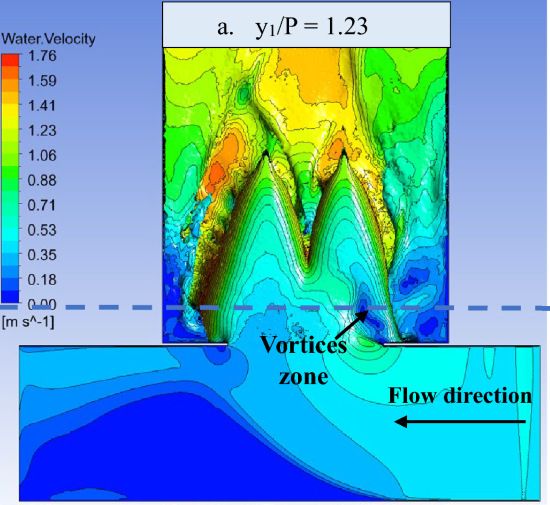
The University of Duhok (UOD) proudly presents a new engineering breakthrough from the Water Resources Engineering Department, College of Engineering. In a newly published study, UOD researchers Bshkoj S. Hussein (corresponding author) and Shaker A. Jalil investigate how modifications in the geometry of labyrinth side weirs can significantly enhance water flow control in open channels. Their research, published in September 2024, marks a significant advancement in hydraulic engineering, relevant to both academic research and practical water infrastructure design.
📄 Title: “Influence of Labyrinth Side Weir Shape Modification on the Hydrodynamic Performance: Experimental and Numerical Study”
📚 Discipline: Civil Engineering – Hydraulic Structures
📅 Published: 16 September 2024
🔍 Study Highlights: Geometry-Driven Efficiency in Side Weir Performance
Side weirs are critical in regulating water levels and diverting flow from main channels. This study examined several geometric modifications to improve their hydraulic efficiency. Using a combination of experimental modeling and advanced numerical simulations (VOF and RNG k-ϵ turbulence models), the researchers evaluated six innovative weir shapes, including:
- Triangular labyrinth side weirs (with and without upstream ramps)
- Curved wing crest side weirs
- Circular crest weirs (with diameters of 2.5 cm, 3.75 cm, and 5 cm)
All configurations were tested under three inclusion angles (30°, 45°, and 60°) and three crest heights (0.1 m, 0.15 m, 0.2 m).
Key Findings:
✅ Curved wing side weirs achieved the highest performance, increasing the discharge coefficient (Cd) by up to 20.7% compared to traditional labyrinth weirs.
✅ Circular crest side weirs with smaller diameters showed a 6.43% increase in discharge efficiency, but performance dropped by 17% as crest diameter increased from 2.5 cm to 5 cm.
✅ Inclusion angle of 30° significantly enhanced flow diversion, producing narrower and more controlled streamlines—0.81 and 0.65 times the main channel width for curved wing and triangular labyrinth shapes, respectively.
✅ The curved wing side weir demonstrated a discharge coefficient 3 times greater than a normal rectangular side weir, confirming its superiority in hydraulic applications.
📈 Strategic Relevance to UOD’s Vision
This research aligns with UOD’s Strategic Plan 2023–2038, particularly in its mission to advance engineering innovation and infrastructure sustainability. By improving water management systems, UOD supports regional development, climate adaptation, and the efficient use of hydraulic resources. It also reinforces the university’s position as a center for applied scientific research in the Kurdistan Region.
🗣 Corresponding Author:
Mr. Bshkoj S. Hussein
Water Resources Engineering Department, College of Engineering, University of Duhok, Kurdistan Region, Iraq
Email: (institutional email can be added upon request)
—
🌍 Practical Applications:
- Optimizing design of spillways, flood control systems, and irrigation channels
- Enhancing discharge capacity in urban and rural water infrastructure
- Informing engineering codes for sustainable hydraulic structure development
🔍 SEO Keywords: labyrinth side weir, hydraulic performance, weir shape optimization, water discharge efficiency, University of Duhok engineering research, RNG k-epsilon simulation, VOF method, civil engineering Kurdistan
📍 UOD Media & Public Relations | June 2025
✍ Prepared by: University Press Office