
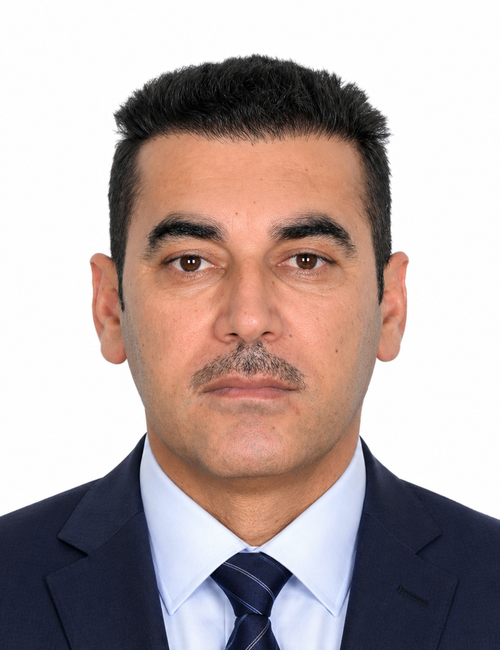
Academic Staff

June 13, 2026, 3:36 a.m.
Naeem Ali Askar (PhD)
Lecturer
Lecturer in Named Data Networking

Mathematics
College of Basic Education
University of Duhok

  • PhD in Named Data Networking, College of Computer Engineering, Karabuk University, 2025.
  • MSc in Computer Science, College of Science, University of Sains, Malaysia, 2012.
  • BSc in Computer Science, College of Education, Salahuddin University, 2004.

Since 2012, I have been a faculty member at the College of Basic Education, University of Duhok, where I teach undergraduate courses in computer science and applied mathematics. My teaching portfolio includes Computer Skills, programming languages—C, C++, MATLAB, and Python—and Numerical Analysis.

I teach with the conviction that theoretical understanding and practical competence must develop together. In programming courses, I design structured exercises and project-based tasks that develop students’ algorithmic thinking and problem-solving skills. In Numerical Analysis, I guide students through mathematical modeling, approximation methods, and computational techniques, using MATLAB and Python to make abstract concepts more accessible.

Beyond classroom teaching, I have contributed to laboratory supervision and curriculum development, ensuring that course content remains aligned with developments in computing and mathematics education. My goal is to prepare students not only for examinations but also for computational thinking and the application of knowledge in scientific and engineering contexts.

I have served as the Coordinator of the Mathematics Department, where I organized academic and administrative activities, supported faculty collaboration, and contributed to the smooth operation of departmental affairs. In this capacity, I also coordinated quality assurance activities, ensuring that academic programs align with institutional standards and reflect a continuous commitment to improving teaching and learning outcomes.

At the international level, I participated in the Venice 1st International Conference on Engineering & Technology, Computer, Basic & Applied Sciences (ECBA-2017) held in Venice, as well as the AVR 2017 Conference on Augmented and Virtual Reality, organized by the Augmented and Virtual Reality Laboratory at the University of Salento. These engagements broadened my exposure to emerging research trends and facilitated broader academic networking.

Research

  1. Askar, N. A., Habbal, A., Hamouda, H., Alnajim, A. M., & Khan, S. (2024). SEF: A smart and energy-aware forwarding strategy for NDN-based Internet of Healthcare. Computers, Materials & Continua, 81(3), 4625–4658.
  2. Askar, N. A., & Habbal, A. (2024). RLEAFS: Reinforcement learning-based energy aware forwarding strategy for NDN-based IoT networks. IEEE Access, 12, 177173–177188.
  3. Askar, N. A., Habbal, A., Zen Alden, F., Wei, X., Alaidaros, H., Guo, J., & Yu, H. (2023). Forwarding strategies for named data networking based IoT: Requirements, taxonomy, and open research challenges. IEEE Access, 11, 78363–78383.
  4. Askar, N. A., Habbal, A., Mohammed, A. H., Sajat, M. S., Yusupov, Z., & Kodirov, D. (2022). Architecture, protocols, and applications of the Internet of Medical Things (IoMT). Journal of Communications, 17(11), 900–918.
  5. Tuama, B. A., Shawkat, S. A., & Askar, N. A. (2022). Recognition and classification of facial expressions using artificial neural networks. In Proceedings of Third Doctoral Symposium on Computational Intelligence: DoSCI 2022 (pp. 229–246). Springer Nature Singapore.
  6. Ahmed, D. H., & Askar, N. A. (2018). Parallelize and analysis LU factorization and quadrant interlocking factorization algorithm in OpenMP. Journal of Duhok University, 46–53.
  7. Alsalihy, W. A. H. A., & Askar, N. A. (2013). Enhancement of redundant reader elimination by using hybrid algorithm in RFID systems. Wireless Personal Communications, 72(2), 1139–1156.

My research interests focus on wireless networks and next-generation internet architectures, with particular emphasis on New Data Networks (NDNs), the Internet of Things (IoT), and the Internet of Medical Things (IoMT). Designing and optimizing routing and rerouting strategies for wide-area, dynamic, and resource-constrained networks is central to this field.

My interests also extend to smart city systems, which integrate IoT devices and diverse connectivity technologies to deliver efficient and intelligent urban services. Within these areas, I pay particular attention to network security, especially lightweight security mechanisms, trust management, and intrusion detection, as fundamental pillars for ensuring reliable and secure connectivity.

Overall, my research aims to contribute to building scalable, efficient, and secure connectivity frameworks that meet the demands of future interconnected systems.

I have ongoing experience supervising graduation projects for fourth-year students in the Mathematics Department at the College of Basic Education, University of Duhok, since 2013. My supervision focuses on topics that combine applied mathematics and computer science, emphasizing the application of mathematical models and methods to solving computational problems, analyzing data, and developing algorithms.

Through supervising these projects, I aim to cultivate students' scientific research and analytical thinking skills, and enhance their ability to apply mathematical concepts in modern technological fields, thus preparing them for postgraduate studies or integration into the job market.